B2B Demand Generation
B2B Event Marketing That Builds Pipeline and Awareness
You're spending tens of thousands — sometimes hundreds of thousands — on events. Booth, travel, sponsorship, swag. Your team comes back with a bowl of business cards and a vague sense it "went well." Three months later, nobody can point to a single closed deal.
The Problem
Events without a plan
B2B event marketing fails in predictable ways. Not because the events are wrong, but because nobody planned what happens before, during, and after.
No pre-event outreach
Your team shows up hoping the right people walk by the booth. No target account list, no pre-booked meetings, no outreach sequence. You're paying for a booth and relying on foot traffic.
No content capture plan
Every event produces hours of conversations, demos, and presentations, and none of it gets captured. No photos worth posting, no video clips, no speaker quotes. The event ends and the content opportunity vanishes.
No follow-up process
Business cards sit in a drawer. Leads hit the CRM two weeks late with no context. The warm handshake at the booth turns into a cold email that reads like every other cold email. Whatever momentum the event created dies in the follow-up gap.
No way to measure what worked
When the CFO asks what the event ROI was, you can't answer. Attendance? Sure. Pipeline sourced? Maybe. Revenue attributed to the event? Nobody tracked it. So next quarter, the same budget gets approved on gut feel, or it gets cut.
What It Costs
The budget moves. The pipeline doesn't.
Event budgets are some of the largest line items in B2B marketing. When they run without a plan, the waste compounds.
Budget without attribution. Tens of thousands per year on events with no clear pipeline connection. Marketing can't defend the spend, so finance starts treating events as discretionary. When the budget gets cut, it's not because events don't work. It's because nobody proved they did.
No compounding between events. Every event starts from scratch. No updated target list from last quarter, no content library building over time, no quarter-over-quarter growth in engaged accounts. You're running four isolated events a year instead of building an approach that compounds.
What Good Looks Like
A B2B event marketing playbook that connects to pipeline
The companies that get ROI from events don't have bigger budgets. They have a playbook — built from the Outcome Marketing methodology — that connects what happens before, during, and after the event to their pipeline and content engine. For the digital infrastructure around your events, see how AI-accelerated delivery supports the full approach.
Pre-event: target accounts and booked meetings
Start with your target account list, the same ICP-grounded list that drives your demand gen. Six to eight weeks before the event, outreach begins: personalized invitations, meeting requests, speaker promotion. By the time you arrive, your calendar is already full.
During: content capture and live engagement
Every event is a content production day. Dedicated capture: photos, short video clips, speaker recordings, booth conversations worth quoting. Your team has a shot list and knows what to collect. Demos and conversations are logged in real time, not reconstructed from memory two weeks later.
Post-event: follow-up within 48 hours
Personalized follow-ups go out while the conversation is still fresh. Leads enter the CRM with context: what was discussed, what they cared about, what the next step is. Nurture sequences activate. Content from the event starts publishing within a week.
Measurement: pipeline sourced, not badges scanned
Track the metrics that matter: ICP accounts engaged, meetings booked, pipeline sourced, content pieces produced, SAM coverage change. Quarterly event reviews feed the next quarter's plan. You know which events are worth repeating and which aren't.
Free Playbook
The B2B Events Playbook
The complete event marketing playbook, from target account identification through post-event content and pipeline measurement. Nine slides covering pre-event, during, and post-event execution. Free, no email gate.
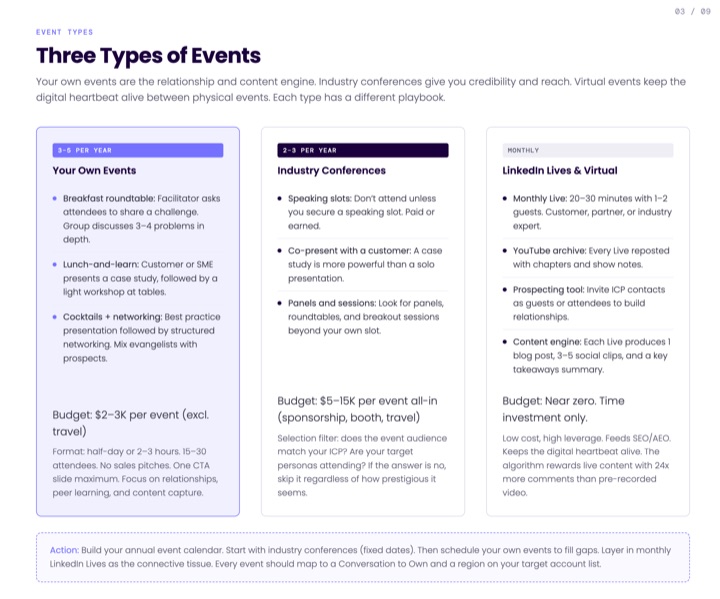 View Events Playbook
Frequently asked questions
-
Focus on pipeline-connected metrics: ICP accounts that attended or engaged, meetings booked at or after the event, pipeline sourced within 90 days, and content assets produced. These connect the event to revenue. Pair them with a quarterly event review that compares cost per pipeline dollar across all your events, so you can double down on the ones that convert and cut the ones that don't.
-
Event sponsorship is writing a check for a logo on a banner. Event marketing is the process around it: pre-event outreach to target accounts, content capture during the event, follow-up sequences after, and pipeline measurement throughout. Sponsorship without marketing is a branding expense. Event marketing turns that same sponsorship into a demand generation channel with measurable pipeline outcomes.
-
For your own hosted events, start 6-8 weeks out: target account identification, speaker coordination, outreach sequences, and content capture planning. For industry conferences you're sponsoring, 2-3 months gives you time to secure your slot, build your outreach list, and promote your presence. For LinkedIn Lives and virtual events, 2-3 weeks is enough. The pre-event work, especially target account outreach and meeting booking, is where most of the ROI is created. The event itself is the middle of the campaign, not the beginning. Outcome Marketing covers the full event-as-demand-gen model in Chapters 9 and 11.
Related services
Fractional CMO
The leadership model that connects event marketing to your broader go-to-market strategy.
Demand Generation
Events are one channel in the demand gen system. See how it all connects to positioning and pipeline.
The Book
The methodology behind the playbook. Strategy to execution to revenue.
Find a practitioner who's done this before
Event marketing systems don't build themselves. Browse the OM marketplace to find a fractional CMO or demand gen practitioner who can build yours.
Browse Marketplace