B2B Customer Journey
B2B Customer Journey Mapping That Stops Revenue Leaks
Marketing generates leads. Sales closes deals. Customer Success manages accounts. Nobody owns the full arc, and revenue leaks at every handoff.
The Problem
Four teams. Four definitions of the buyer.
Marketing targets one ICP. Sales qualifies against a different set of criteria. Customer success inherits accounts with no context on what was promised. And expansion revenue sits untouched because nobody mapped the path from onboarding to upsell.
The result is a journey that exists in name only. Each team optimizes its own stage, and the gaps between stages are where revenue disappears. MQL-to-SQL handoffs are undefined. Post-sale onboarding is disconnected from the sales narrative. Expansion triggers are invisible because nobody is looking at the full arc.
What It Costs
The gaps you can measure, and the ones you can't
Churn at predictable points
Customers leave at the same moments: post-onboarding, first renewal, feature adoption plateau. These aren't surprises. They're unmapped transitions where nobody owns the handoff.
Expansion revenue untouched
Upsell and cross-sell opportunities exist in every account. Without a mapped journey from initial use case to expanded value, CS teams manage accounts instead of growing them.
Acquisition obsession, eroding foundation
Marketing pushes new logos. Sales is comped on new bookings. Meanwhile, churn eats the base. The irony: most of your inbound is branded search — driven by the installed base you're neglecting.
NPS that doesn't translate
High NPS scores and low referral rates. Satisfied customers who don't expand, don't refer, and don't renew at higher tiers. The relationship exists, but the journey to deeper engagement was never designed.
What We Build
A journey map that marketing, sales, and CS all use
Outcome Marketing practitioners build full-funnel journey maps from first touch through expansion. Not a workshop artifact. A working document with entry and exit criteria at every handoff, ICP validation across stages, and a CS-to-marketing feedback loop that completes the arc.
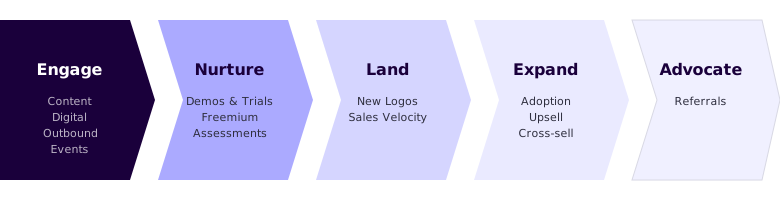
Full-funnel journey map
From first touch through expansion and referral. Every stage defined with the actions, content, and ownership that move buyers forward.
Handoff definitions
Entry and exit criteria at every transition. Marketing to sales, sales to CS, CS to expansion. No ambiguity about when a handoff happens or what the receiving team gets.
ICP validation across stages
One ICP definition that every team qualifies against — marketing, sales, and CS. Not static. It evolves as CS data reveals which customers succeed and that feeds back into marketing.
CS-to-marketing feedback loop
What CS learns about customers flows back to marketing. Churn reasons sharpen messaging. Expansion patterns inform demand gen targeting. The journey improves with every cycle.
Where to Focus
Revenue tells you who's paying. Penetration tells you where to invest.
Your CRM ranks accounts by revenue. Your team allocates attention by whoever's loudest. Neither tells you where the growth is. A $30K account that's adopted one product out of ten isn't a small account — it's a $300K account that's 10% realized.
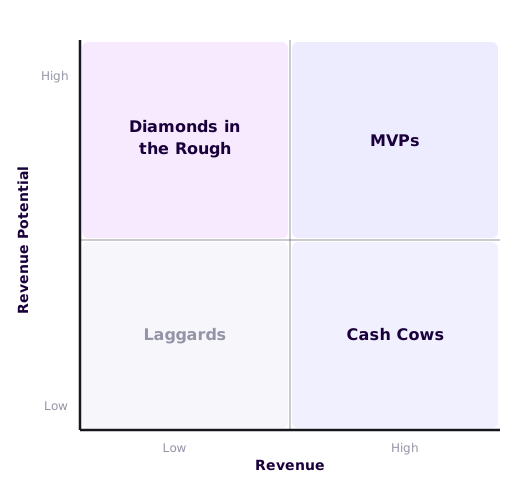
ICP fit determines the row. Product penetration tells you the column.
Diamonds in the Rough
ICP, 0-15% penetrated. They've landed an initial product but barely scratched the surface. These look like small accounts in your CRM, but they have the highest expansion potential. This is where your best reps should be spending time.
MVPs
ICP, 15-40% penetrated. Adopted and engaged, ready for upsell and cross-sell. The expansion motion is warm — they already trust you.
Cash Cows
ICP, 40%+ penetrated. Stable, trained, not going anywhere. Low-touch. Keep them happy and use them for advocacy.
Laggards
Non-ICP, low penetration, often high support. Smaller companies that consume disproportionate resources. Digital or self-serve motion — don't over-invest.
The journey map tells you where handoffs break. The priority matrix tells you what to fix first.
Free Template
B2B Customer Journey Map Template
Map your full customer journey from first touch through expansion. Includes stage definitions, handoff criteria, and ICP validation checkpoints. Non-gated.
Download Journey Map TemplatePatterns We See
Journey gaps show up in the numbers before anyone names them
The cheapest product to land was getting the least investment
At one B2B SaaS company, the product with the lowest cost to land — $0.60 per dollar of new bookings versus $1.00 for every other product — was getting the least investment. A quarter of expansion-ready accounts hadn't been contacted in six months.
The highest-revenue customers were the least profitable
At another, the highest-revenue customers were also the least profitable — steep discounts and dedicated support that ate the margin.
These aren't strategy failures. They're journey failures — the map didn't exist, so nobody could see where the leverage was.
Frequently asked questions
-
A B2B customer journey map is a structured document that defines every stage a buyer moves through, from first awareness of your company through purchase, onboarding, adoption, expansion, and referral. Unlike B2C journey maps that focus on individual purchase decisions, B2B journey maps account for multiple stakeholders, longer sales cycles, and post-sale revenue stages. A useful B2B journey map includes entry and exit criteria at every handoff, ICP validation at each stage, and clear ownership assignments for marketing, sales, and customer success.
-
B2B buyer journeys involve multiple decision-makers, longer evaluation periods, and post-sale stages that often generate more revenue than the initial deal. A B2C journey typically ends at purchase. A B2B journey extends through onboarding, adoption, expansion, and renewal. The handoffs between teams matter more in B2B because the customer relationship spans months or years, and revenue compounds through upsells, cross-sells, and referrals. Mapping a B2B journey means designing for the full lifecycle, not just the funnel.
-
Revenue leaks at the sales-to-CS handoff when the receiving team doesn't know what was promised, which use cases the buyer prioritized, or what success looks like in the first 90 days. The fix is a structured handoff with defined fields: buyer goals, promised outcomes, implementation timeline, and expansion triggers. A joint call with sales, onboarding, and the customer ensures all three are aligned before the transition happens. This isn't a CRM note — it's a documented transition with entry criteria (what CS needs before accepting the account) and exit criteria (what sales must deliver before the handoff is complete). When the handoff is defined, onboarding starts faster, time-to-value shortens, and early churn drops.
-
Not by revenue. Revenue tells you who's paying today — it doesn't tell you who's worth investing in. A more effective model segments by ICP fit and product penetration. Customers who match your ICP but have only adopted one product (0-15% penetration) are your highest-growth accounts — they look small in your CRM but have massive expansion potential. Customers at 15-40% penetration are ready for upsell and cross-sell. Customers above 40% are stable — keep them happy and use them for advocacy. Non-ICP customers with low penetration and high support needs should get a digital or self-serve motion, not dedicated reps. LTV:CAC is the metric that validates the model — it tells you whether the accounts you're investing in are returning more than they cost to acquire and grow. This segmentation drives different journey motions for different customer types instead of treating every account the same.
-
Many journey maps fail because they become static documents — a workshop artifact that gets filed and never reopened. Three things kill them. First, no ownership: the map shows stages but nobody owns the transitions, so handoffs fall through the cracks. Second, the initial cross-functional energy fades. The first few meetings have momentum, then teams stop showing up and the map stops evolving. Third, the company gets pulled back into old patterns. Sales over-promises, onboarding gets left in a lurch, the loudest customers get all the attention, CS stops talking to marketing, and marketing goes back to chasing new logos. The map exists, but the organization routes around it. A journey map that works needs assigned ownership, a recurring review cadence, and incentives that reward the journey — not individual team metrics.
Related services
Fractional CMO
The leadership layer that connects journey mapping to your broader go-to-market system.
Sales Playbook
The rep-facing process that operates within the journey map. Built from the same ICP and handoff definitions.
Demand Generation
Top-of-funnel entry points that feed the journey. Positioning and channel strategy grounded in your bets.
Map the journey. Close the gaps.
Find a practitioner who builds journey maps grounded in methodology, not workshop exercises.
Browse Marketplace